

On November 10, 2026, the School of Management successfully hosted a session of its High-end Foreign Expert Lecture Series in Room 812 of the Administration Building. The lecture featured Dr. Feng Zhan, Associate Professor of Finance, Research Director of the DAN Department of Management and Organizational Studies, and DANCAP Private Equity Professor in Change and Innovation at Western University, Canada. He delivered a keynote report titled Role Reversal: Academic Paper Submission and Processing from an Editor's Perspective. Several faculty members and graduate students from the School attended the lecture and engaged in in-depth exchanges and discussions with Dr. Zhan.
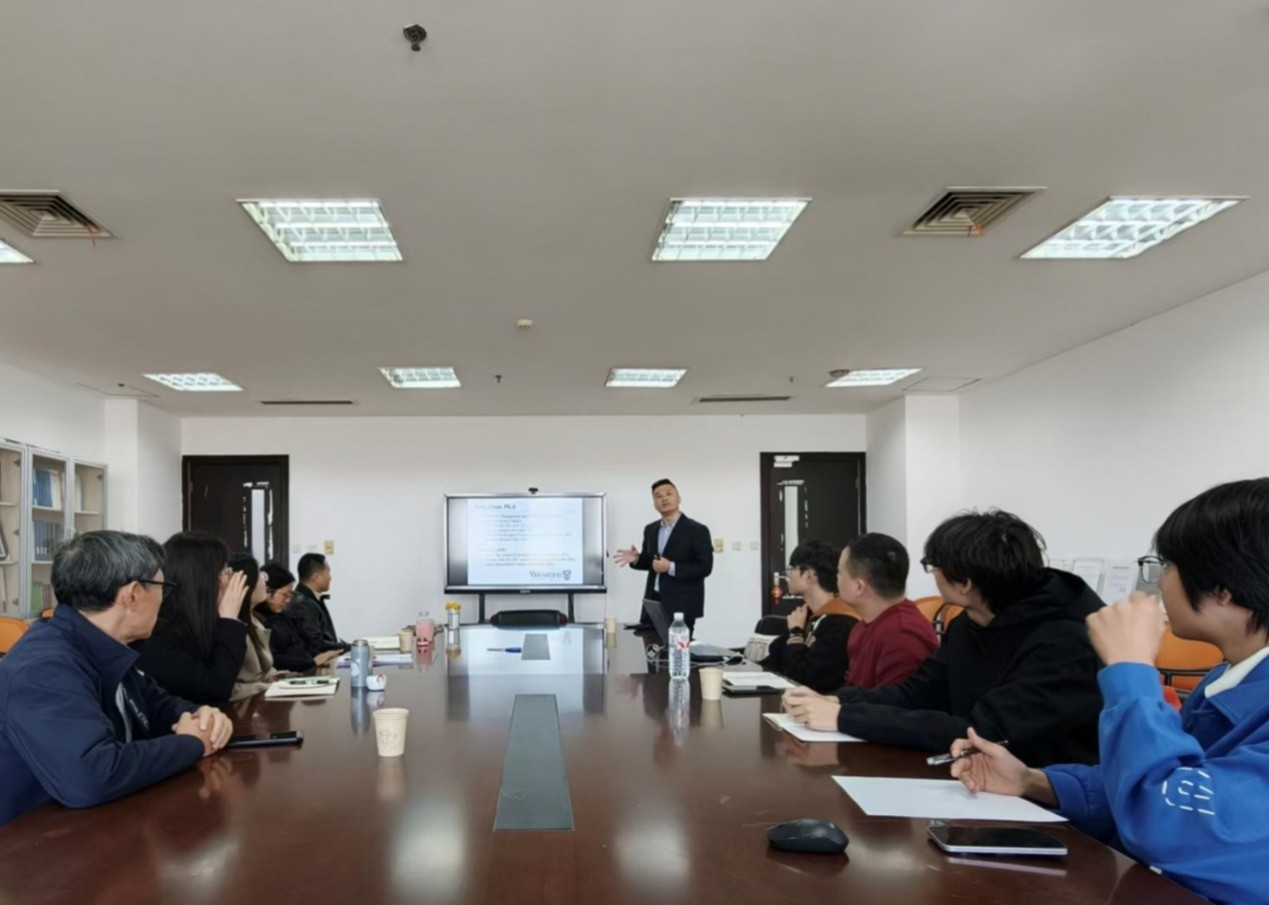
At the beginning of the lecture, Dr. Zhan used the concept of role reversal as a starting point. Adopting the perspective of an international journal editor-in-chief, he provided a comprehensive analysis of the entire academic paper submission and processing workflow for the attending faculty and students. He meticulously broke down the manuscript selection criteria during the editorial initial review, analyzed the key concerns of external peer reviewers, and conducted an in-depth diagnosis of revision strategies and common reasons for rejection. By integrating typical manuscript cases, Dr. Zhan shared highly practical submission experiences.
When addressing academic norms and the editorial review bottom line, Dr. Zhan integrated current trends in academic publishing to analyze in simple terms the many details that editors-in-chief pay close attention to. He reminded faculty and students that in addition to strictly adhering to the bottom line of plagiarism check rates and preventing structural duplication of core viewpoints, they should also focus on genuine and effective academic dialogue in literature citations to avoid meaningless stacking. Furthermore, regarding the currently widely discussed use of AI tools, Dr. Zhan emphasized that researchers should accurately grasp the boundary of human-computer collaboration. Although AI can serve as an auxiliary tool for language polishing or literature review, it must never cross the boundary to replace the author's core creative work.
During the interactive Q&A session, the atmosphere was lively. Attending faculty members engaged in thorough discussions with Dr. Zhan on topics such as the application and boundaries of AI in scientific research, as well as specific challenges encountered during SSCI submissions. Dr. Zhan patiently answered the questions from faculty and students, offering numerous constructive revision suggestions. Attendees expressed that through this lecture, they not only clearly understood the underlying logic of manuscript processing from an editor-in-chief's perspective but also gained a clearer understanding of how to standardize the use of AI to assist scientific research, benefiting greatly from the event.
The successful hosting of this high-end foreign expert lecture not only provided a platform for face-to-face communication between the faculty and students of the School of Management and top international scholars but also further broadened the international academic vision of our faculty and students. It holds significant importance for enhancing the academic norms awareness of the School and promoting the writing and publication of high-level international papers.
